Majority of people in India are intelligent and can ‘read between the lines’. To be educated and intelligent one need not be literate. Ofcourse literacy is a source of education, if the education is only through the print. Today audiovisual media is a great source of education.
Majority of Hindus are secular. And that is how India has remained secular.
Urban literate (I am deliberately not using the word educated) middle class is not really secular. You can visit ‘Rediff’ discussion boards if you do not believe me.
BJP managed to exploit religious gullibility of the masses once. There after they have failed.
BJP’s agenda for 2009 elections was, uniform civil code (I want uniform civil code, but not imposition of some code in the name of uniformity), construction of Ram mandir, Rama rajya, abrogation of article that provides special status to Kashmir and doing away with ‘pseudo secularism’. BJP also made it clear that these promises could not be implemented in a coalition government.
Why did they get into coalition? They should have fought the election on their own if they really wanted to implement all that they stood for. One possibility is they do not really believe in what they say. May be they thought all Hindus were like those urban literate middle class. Thanks to audiovisual media Indians can ‘read between the lines’.
There has been a social change. Members of the caste, who are at the bottom rung of Hindu social ladder within the fourfold Hindu society, have acquired wealth and power.
They resist being labelled number four. They have made their presecne noticeable in every political party. This has resulted in top three rungs showing uneasiness. While other parties have accepted social change, BJP remains upper caste at the top. BJP could unite all the castes just once. It remains to be seen whether they can do it again. The bottom rung is a very complex caste. There are innumerable groups within this caste, which makes it difficult to bring them together. Each group is a vote bank. Strangely the expression ‘vote bank’ is used only where Muslims are concerned.
Sunday, May 24, 2009


Sunday, April 19, 2009
Jeevan Das of 'green ply' plywood

Click on the image to enlarge.
Jeevan das is young, Jeevan Das is middle aged and Jeevan Das is old and similarly prosecuter also advances in age. The ad is about greenply plywood, which during this lengthy period has withstood the hammerings by the judge. This small ad has given tremendous insight into the judicial process in our country.
Jeevan Das was a young upright man working as a junior executive in a PSU. He was required to sign invoices both for sale and stock transfers by rail, and trucks against cash receipts issued by different locations. Contractors for stock transfers were appointed by different office. Supplies were made against delivery orders and cash receipts issued by different offices of the same PSU.
Cash receipts and delivery orders were checked and the current delivery and balances of delivery order quantity and cash receipts were noted in the columns provided on the reverse of the documents by an assistant. The assistant after these checks and balances issued a blank but serially numbered invoice to a typist clerk. The typist clerk typed the challan giving the details of cash receipt, reference of delivery order and then passed on the entire bunch to Jeevanl Das for his signature. In the course of time it became a routine for Jeevan Das to sign the invoices. Signing the invoices was one small part of his job. As a unit head he had many other functions.
Some stock transfers did not reach their location. But the stock transfers were effected through authorised trasporters appointed by another office. He signed an invoice for sales, which was put up to him after completing the formalities by the assistant and the typist clerk. After a year it was found that the cash receipt was counterfeit. Matter was reported to police.
Management of JeevanDas did not find any fault with him and filed FIR for recovery of goods from the contractor. He continued in his job.
After five years of investigation police filed a criminal case against Jeevan Das.
He received court summons and appeared before the court with a lawyer arranged by one of his colleagues.
once he reported, he was told he was under arrest and had to obtain bail of Rs. 30000/- Jeevan Das had never seen thirty thousand at any time in his life and was in a state of shock. But 'peshkar'( court clerk) came to his rescue. there was a wonderful system of obtaining bail. There were some registered 'bailers', who charged ten percent of bail amount to stand surety. JeevanDas managed RS.3000/- pooled and given to him by some of his colleagues. Peshkar's fees were additional.
JeevanDas’s journey to court begins at the age of thirty-six.
‘Jeevan Das ko kadi se kadi saza milni chahiye’ says police prosecutor. Jeevan Das was charged for conspiracy and cheating along with the contractor. In the court he was almost treated like a criminal and not accused. The lawyer would demand his fees in advance and some times would not even turn up resulting in adjournments. Lawyers would order tea and snacks for their colleagues as well and would ask Jeevan Das to pay. Afterall lawyers say “We do not render any service to the litigant-----it would be harsh to make lawyers pay for alleged deficiency in service under the consumer law”.
Prosecution took four years to present twenty witnesses; Jeevan Das had never seen them before except four from his office, who narrated the procedure of despatches. All other witnesses told the court how the contractor sold the goods to them. Even then the judge took cognisance and proceeded with the trial of JeevanDas. Years rolled by but cross-examination of witnesses was not even half way through. Twenty years after the case began just fifteen witnesses were examined. JeevanDas was fiftysix and the case continued.
I am grateful to ‘greenply’ plywood advertisement for providing inspiration. Green ply’s strength is symbolic of our judicial process. ‘Chalata Rahe Chalta Rahe!’
Saturday, April 18, 2009
Nehru and his great grand son
Varun Gandhi thus spoke in Pilibhit as reported by PTI on their web site.
"This is not not a 'Hand' (Congress symbol), it is the power of the 'Lotus' (BJP symbol). It will cut the head of ....... Jai Shri Ram,"
, "All the Hindus stay on this side and send the others to Pakistan. This is the Lotus (BJP symbol) hand, it will cut their throats after elections. They have names such as Karimullah, Mazurullah. If you see them in the night you would get scared."
"If anyone raises a finger towards Hindus or if someone thinks that Hindus are weak and leaderless, if someone thinks that these leaders lick our boots for votes, if anyone raises a finger towards Hindus, then I swear on Gita that I will cut that hand."
It is interestig that only Naqvi and Shah Nawaz Husain of BJP said that what Varun said was not the view of BJP. But no comments came from any other leader of BJP. If you see the discussion board of rediff, you find majority have appreciated Varun’s stand. But alas! Varun has denied having said anything to that effect. Subsequently 'important' leaders supported him. He said it was doctored. Varun lacks courage of conviction.
The latest is:
New Delhi, April 18: Defending the action taken against Mr Varun Gandhi, the Chief Election Comm-
issioner, Mr N. Gopala-swami, on Saturday said his controversial speeches in Pilibhit were virulent and “much more than” what was shown on TV.
Ahead of his demitting office on Monday, he said in interviews that the fact of the matter was a stronger message must go.
“We said file a case and all cases have been filed. So the virulence of the particular incident is such that we had to go beyond what normally we keep as our limit. I think is perfectly valid as far as I am concerned,” he said.
Asked if the commission studied the tapes, Mt Gopalaswami said, “yes, we did see. It was much more than what was seen on television. We never felt the tapes which we got were doctored.”
And Gopalswamy is considered sincere even by BJP except, perhaps, in this case.
"This is not not a 'Hand' (Congress symbol), it is the power of the 'Lotus' (BJP symbol). It will cut the head of ....... Jai Shri Ram,"
, "All the Hindus stay on this side and send the others to Pakistan. This is the Lotus (BJP symbol) hand, it will cut their throats after elections. They have names such as Karimullah, Mazurullah. If you see them in the night you would get scared."
"If anyone raises a finger towards Hindus or if someone thinks that Hindus are weak and leaderless, if someone thinks that these leaders lick our boots for votes, if anyone raises a finger towards Hindus, then I swear on Gita that I will cut that hand."
It is interestig that only Naqvi and Shah Nawaz Husain of BJP said that what Varun said was not the view of BJP. But no comments came from any other leader of BJP. If you see the discussion board of rediff, you find majority have appreciated Varun’s stand. But alas! Varun has denied having said anything to that effect. Subsequently 'important' leaders supported him. He said it was doctored. Varun lacks courage of conviction.
The latest is:
New Delhi, April 18: Defending the action taken against Mr Varun Gandhi, the Chief Election Comm-
issioner, Mr N. Gopala-swami, on Saturday said his controversial speeches in Pilibhit were virulent and “much more than” what was shown on TV.
Ahead of his demitting office on Monday, he said in interviews that the fact of the matter was a stronger message must go.
“We said file a case and all cases have been filed. So the virulence of the particular incident is such that we had to go beyond what normally we keep as our limit. I think is perfectly valid as far as I am concerned,” he said.
Asked if the commission studied the tapes, Mt Gopalaswami said, “yes, we did see. It was much more than what was seen on television. We never felt the tapes which we got were doctored.”
And Gopalswamy is considered sincere even by BJP except, perhaps, in this case.
Friday, April 17, 2009
Dalits and Tribals
‘Caste bias can't be equated with racism: India’ (18 Apr 2009, 0428 hrs IST, Indrani Bagchi, TNN) has two issues:
1) Caste discrimination is equated with racial discrimination.
2) Of giving tribals the status of "indigenous people".
In both the cases there is hypocracy. It is a fact that discrimination does take place and it is also a fact that Aryans, Kushans, Hans, Pershians, Turks, Arabs and Afghans were all invaders, who made India their home. Aryans called "indigenous people" ‘rakshasas’ and ‘nagas’. It is high time we apologise to tribals and dalits for the atrocities committed against them.
The news in NDTV web site should make us look within. The Govenment of India should accept the reality with dignity and come clean.
Employment bias mars private sector – Study (NDTV)
Adhana Sharma
Saturday, October 27, 2007 (New Delhi)
The private sectors' refrain that affirmative action is good enough may not stand now. Fresh studies have proved that there is discrimination in employment.
It was subject of much dispute - many had been saying it, others contesting it. On Friday, a study was released by the Indian Institute of Dalit Studies in collaboration with Princeton University.
The study was conducted against 548 job advertisements with 4808 applicants over 66 weeks, across five metros.
It reveals that in fact a person's caste and religion could be a hindrance in getting a job, despite equal qualification.
Inequality in private sector
The study says that a dalit had 60 per cent less chances of being called for an interview, and a Muslim had 30 per cent less, as against their higher caste peers.
The wage earnings too were found to five to 20 per cent lower, between SC as compared to upper castes.
And that is not all, one may also carry the baggage of family background, when being interviewed for a job.
''Here in India, it is a routine practice for employers to enquire about family background and use it as a means for screening. This is an anti-thesis to what one expects in a merit based system,'' Professor Katherine S Newman, Princeton University.
The survey contradicts what employers have been claiming all this while that jobs are given purely on merit, a contradiction that needs to be addressed urgently.
''The result of the studies need to be taken seriously and we need an equal opportunities policy in the form of reservation in addition to what everyone is already doing,'' Professor Sukhdev Thorat, report author and UGC chairperson.
Affirmative action, like skill and enterprise development, taken up by the private sector so far, may just not be enough, if employment opportinities in the country are to become inclusive.
1) Caste discrimination is equated with racial discrimination.
2) Of giving tribals the status of "indigenous people".
In both the cases there is hypocracy. It is a fact that discrimination does take place and it is also a fact that Aryans, Kushans, Hans, Pershians, Turks, Arabs and Afghans were all invaders, who made India their home. Aryans called "indigenous people" ‘rakshasas’ and ‘nagas’. It is high time we apologise to tribals and dalits for the atrocities committed against them.
The news in NDTV web site should make us look within. The Govenment of India should accept the reality with dignity and come clean.
Employment bias mars private sector – Study (NDTV)
Adhana Sharma
Saturday, October 27, 2007 (New Delhi)
The private sectors' refrain that affirmative action is good enough may not stand now. Fresh studies have proved that there is discrimination in employment.
It was subject of much dispute - many had been saying it, others contesting it. On Friday, a study was released by the Indian Institute of Dalit Studies in collaboration with Princeton University.
The study was conducted against 548 job advertisements with 4808 applicants over 66 weeks, across five metros.
It reveals that in fact a person's caste and religion could be a hindrance in getting a job, despite equal qualification.
Inequality in private sector
The study says that a dalit had 60 per cent less chances of being called for an interview, and a Muslim had 30 per cent less, as against their higher caste peers.
The wage earnings too were found to five to 20 per cent lower, between SC as compared to upper castes.
And that is not all, one may also carry the baggage of family background, when being interviewed for a job.
''Here in India, it is a routine practice for employers to enquire about family background and use it as a means for screening. This is an anti-thesis to what one expects in a merit based system,'' Professor Katherine S Newman, Princeton University.
The survey contradicts what employers have been claiming all this while that jobs are given purely on merit, a contradiction that needs to be addressed urgently.
''The result of the studies need to be taken seriously and we need an equal opportunities policy in the form of reservation in addition to what everyone is already doing,'' Professor Sukhdev Thorat, report author and UGC chairperson.
Affirmative action, like skill and enterprise development, taken up by the private sector so far, may just not be enough, if employment opportinities in the country are to become inclusive.
Friday, April 3, 2009
INDIANOIL-LBP
In February or early March 1995 I received my first promotion order after putting in 25 years of service. I said first promotion because it was in five years. Grade ‘A’ to ‘B’ it took 12 years and ‘B’ to ‘C’ 8 years and they were really not promotions but just considerations based on management’s understanding with the officers’ association.
Unfortunately, a few days after my orders I suffered MI (heart attack) and was hospitalised and there after I was on leave as advised by doctor to take rest. When I joined duty some time in May, I was told by Manimuthu that Ram Mohan, then GM, had asked to verify whether I faked an attack to avoid tranfer.
My requests for change of tranfer order to Regional office instead of Lube Blending Plant were not considered. I never asked for retention.
I joined Lube Plant. I got accommodation in guesthouse from where the plant was about 8 kilometers. But half the distance was through a very crowdwd road. From underbridge leading to Kurrukupet the road was along the railway tracks. One could not see the tracks because on either side of the road for a stretch of 2 kilometers there were huts. Women were seen washing clothes and utensils and children easing themselves sitting on the edge of footpath. There were two level crossings and invariably gate would be closed for some train to pass resulting in traffic chaos.
I just wish to share the suggestion that I gave under the ‘suggestion scheme’, which will explain the atmosphere in the plant. Here are the scanned copies.


I did not receive any communication to say my suggestion was rejected. I followed up with Satish but got evasive replies.
My purpose in submitting my suggestion was to express to the management my views on the chaotic working conditions in the plant.
Unfortunately, a few days after my orders I suffered MI (heart attack) and was hospitalised and there after I was on leave as advised by doctor to take rest. When I joined duty some time in May, I was told by Manimuthu that Ram Mohan, then GM, had asked to verify whether I faked an attack to avoid tranfer.
My requests for change of tranfer order to Regional office instead of Lube Blending Plant were not considered. I never asked for retention.
I joined Lube Plant. I got accommodation in guesthouse from where the plant was about 8 kilometers. But half the distance was through a very crowdwd road. From underbridge leading to Kurrukupet the road was along the railway tracks. One could not see the tracks because on either side of the road for a stretch of 2 kilometers there were huts. Women were seen washing clothes and utensils and children easing themselves sitting on the edge of footpath. There were two level crossings and invariably gate would be closed for some train to pass resulting in traffic chaos.
I just wish to share the suggestion that I gave under the ‘suggestion scheme’, which will explain the atmosphere in the plant. Here are the scanned copies.


I did not receive any communication to say my suggestion was rejected. I followed up with Satish but got evasive replies.
My purpose in submitting my suggestion was to express to the management my views on the chaotic working conditions in the plant.
Tuesday, March 31, 2009
INDIANOIL-IMPHAL
It was in the middle of December 1976 that I went to Imphal, the capital of Manipur, on posting as Depot Superintendent. With me was my wife and three and a half year old son, Monis. We reached Imphal at about 10 O’clock in the morning. Weather was very cold.
We straightaway went to our house, which was kept for us by Mr.Ujwal, the outgoing DS. Our neighbour Mr.Datta and his wife came and gave us a helping hand. Our belongings, which we sent from Calcutta two days earlier, were yet to reach. We could not manage the climate with what we had carried with us. We shifted to a hotel. Our belongings that we had sent from Calcutta arrived almost after ten days.
Imphal is a beautiful town surrounded by hills and is capital of Manipur state. I worked in Imphal from December 1976 till June 1980. Majority of Manipuris are Vaishnavites (a sect among Hindus). Tribals such as Kukis and Tankhuls inhabit surrounding hills. All of them are Christians. Chritian missionary work is appreciable, particularly in the field of education, in Manipur. All well managed schools are missionary schools. Kukis inhabit the hills of Churachandpur and Tankhuls the hills of Ukharul.
The valley population is Hindu vaishnavite. Roughly two hundred years ago Shanti Das, a desciple of Chatanya Maha Prabhu with missionary zeal, visited Imphal and under his influence the tribal king of Manipur valley converted to Vaishnavism. The ‘praja’ followed the king and accepted vaishnavism. Their earlier dieties are worshipped even now. In fact there was a movement for revival of the past.
Imphal was the only Depot where a full CRPF section was posted. They lived at one end of depot with their tents almost touching tankform of two vertical tanks.
Imphal was a road fed depot and the supplies were from Khatkhati, a town in Naga Land. Road between Imphal and Khatkhati war hilly and some stretches were as high as 7000 feet. During the rainy season there used to be landslides resulting in blockage of roads. We had the storage capacity of a month’s requirement. The depot had hardly any facilities. There was no TLF bay, which meant I had to climb each Tank truck twice-once on arrival and second time after product was decanted or topped up for despatch. Topping up was necessary because there was at least 5 to 6 degree teperature variation between loading temperature and temperature on arrival at Imphal.We received about 15 to 20 trucks each day. This had its effect on my health. I developed lower back pain. Even to this day I suffer.
My junior in Bombay University and hostel mate, Dinamani Singh, was an officer of State Government. Through Dinamani I got to know Sattar, who was his colleague. Both were in state public service. They included my name in the state VIP list. I got invitation for Republic and Independence day parades in the VIP enclosures. I along with my family enjoyed State government hospitality. I also received invitations for tea party at Chief Ministers residence on both the occasions every year.
It was in 1977 that during the rainy season our stocks depleted to about a week’s requirement. The other oil company was Assam Oil looked after by Mannalal, a dealer of AOC. Under secretary in the ministry of civil supplies called for a meeting, which was attended by all our dealers and AOC representative. Mr.Sharma, under secretary, told me that IOC was given licence to operate the depot on a clear cut condition that a month’s stocks would be available at any given time. He threanened that he would cancel our licence sinca we did not keep the promise. All my explanations were not accepted. I excused myself and came out of the meeting and booked a lightening call to our DGM Mr. Datta, who was at Calcutta. He told me to go back and ask Mr. Sharma if he could cancel immediately and that we were ready to pack up.
I went in and told him what I was told by my DGM. There was a stunned silence. Mr. Sharma had nothing to say. Meeting was abruptly concluded. By the time I reached the depot there was a message from the secretarit that Additional Chief Secretary wanted me to meet him immediately. I rushed back to the secretariat and went to Mr. Mathur, who was the additional CS. He received me with warmth and told me to forget what happened with Sharma. He said Sharma was a fool and did not know IOC and the implications of cancelling the licence.
There was a theft of lubricating oilcans from the depot. I sent a letter to the police station. The DSP called me but I could not go. He came to our depot and was very harsh and said that without my complicity theft could not have taken place. He left asking me to see him in his office. I rang up IG Mr.Lal and told him what had happened. He assured me that he would talk to the DSP and that I was not to go to DSP’s office. Never heard from the DSP again.
Once I was getting back from my depot and a few yards from my house a cow rushed out of a bush and hit my scooter. I was thrown off the scooter. My thumb was crushed; nail was almost out and was profusely bleeding. There were many people watching but none came to my help. I managed to get up and lift my scooter and reach home.
Manipuris always considered people from other parts of India as foreigners. They always said that we had usurped their land.
From 1979 onwards Peoples’ Liberation Army, a cecessionist organisation of Maitis (manipuri hindus call themselves maitis), was very active. Their leader was Bhishan Singh, a legendary figure for manipuris. Ambushes of army convoys harassment of non-manipuris particularly Bengalis was very common. They believed that the root cause of their problems was Bengali domination. In their private conversations after a few pegs they would talk of how their culture was eroded by the bangalis who brought vaishnavism to the valley. Since I had business relations, I was respected. Manipuris refer to non-manipuris as ‘mayang’, which means a foreigner.
During this period they revived their old and forgotten deities and celebrated their old festivals with gusto. Many talked about abandoning vaishnavism. They are vegetarians and fish for them is a vegetarian item. They cannot think of a meal without fish. They make a number of dishes with fish and each tastes different from the other.
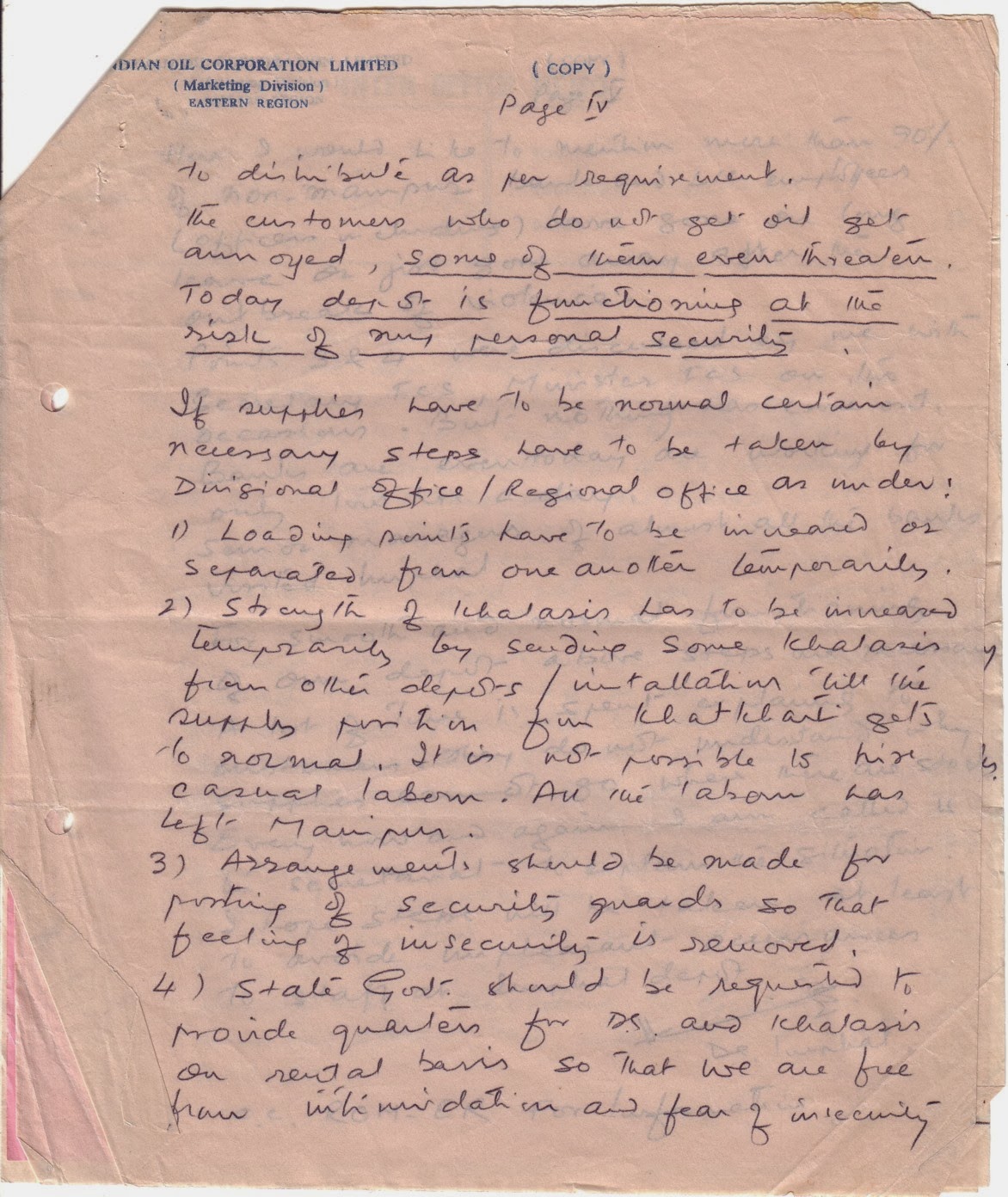
Serous trouble started in early 1980.The CRPF posted in the depot were withdrawn. When I met IGP he said they could be easy target for the extremists. There after the depot and the depot staff was feeling unsafe. There were curfews and flag marches. Army and paramilitary people used to come to my house and take me to depot and after their requirements were given they used to drop me back home. For civilian requirement I operated from my house. Loaded tank trucks were safe in Assam rifles. I issued sales documents from my house. With escort I used to go to SBI and deposit Demand Drafts. This continued for almost a month. We were confined to the house. The anti ‘outsider’ feeling among the people was very venomous. Many Bihari labourers left Imphal. Many non-manipuris were beaten up and told to leave. A large majority took shelter in schools.
Amrita Bazar Patrika’s staff correspondent wrote an article’ Behind The Manipur Violence’, which appeared in their May 14,1980 edition (the paper called it a communal violence. It was violence for independence and deportation of all non-manipuris from Manipur.) and an editorial in the same paper on 19th May 1980. Statesman of May 20, 1980 carried a small news item ‘ banks reopen in Imphal’it says the clearing house of banks was closed for 22nd day today’ it was a very significant news item and I am sharing a scanned copy along with some more scanned news reports with the readers.


The 'foreign Nationals' is infact what Manipuris called Indians 'mayang'.

Click on images to enlarge.
The amount of tension and insecurity felt by the non-manipuris cannot be described. It was very unfortunate that my office in Calcutta, despite my day-to-day reporting on the situation, remained silent. One – a sardar in Gauhati, I do not remember his name and come to think of it it is not worth remembering, and the other, head of the region in Calcutta, who was a mean character but thought very high of himself, were callous on what was happening.
Many army and para military vehicles used to come to my house to escort me to depot for their requirements and I think I must have been a noted person among the extremists. One morning three boys forced themselves into my house, closed the door from within and pulled out their revolvers from under the shawls they had wrapped around their body. They thought I owned the depot and demanded Rs 20000/-. My wife and childeren were frightened. They rummeged all my belongings and found just Rs 500/-. They warned me and left. My landlord was watching from outside. DIG of police was staying next door but no one came to my help. We decided to quit Imphal come what may.
Here are my letters to Gauhati and Calcutta:



We straightaway went to our house, which was kept for us by Mr.Ujwal, the outgoing DS. Our neighbour Mr.Datta and his wife came and gave us a helping hand. Our belongings, which we sent from Calcutta two days earlier, were yet to reach. We could not manage the climate with what we had carried with us. We shifted to a hotel. Our belongings that we had sent from Calcutta arrived almost after ten days.
Imphal is a beautiful town surrounded by hills and is capital of Manipur state. I worked in Imphal from December 1976 till June 1980. Majority of Manipuris are Vaishnavites (a sect among Hindus). Tribals such as Kukis and Tankhuls inhabit surrounding hills. All of them are Christians. Chritian missionary work is appreciable, particularly in the field of education, in Manipur. All well managed schools are missionary schools. Kukis inhabit the hills of Churachandpur and Tankhuls the hills of Ukharul.
The valley population is Hindu vaishnavite. Roughly two hundred years ago Shanti Das, a desciple of Chatanya Maha Prabhu with missionary zeal, visited Imphal and under his influence the tribal king of Manipur valley converted to Vaishnavism. The ‘praja’ followed the king and accepted vaishnavism. Their earlier dieties are worshipped even now. In fact there was a movement for revival of the past.
Imphal was the only Depot where a full CRPF section was posted. They lived at one end of depot with their tents almost touching tankform of two vertical tanks.
Imphal was a road fed depot and the supplies were from Khatkhati, a town in Naga Land. Road between Imphal and Khatkhati war hilly and some stretches were as high as 7000 feet. During the rainy season there used to be landslides resulting in blockage of roads. We had the storage capacity of a month’s requirement. The depot had hardly any facilities. There was no TLF bay, which meant I had to climb each Tank truck twice-once on arrival and second time after product was decanted or topped up for despatch. Topping up was necessary because there was at least 5 to 6 degree teperature variation between loading temperature and temperature on arrival at Imphal.We received about 15 to 20 trucks each day. This had its effect on my health. I developed lower back pain. Even to this day I suffer.
My junior in Bombay University and hostel mate, Dinamani Singh, was an officer of State Government. Through Dinamani I got to know Sattar, who was his colleague. Both were in state public service. They included my name in the state VIP list. I got invitation for Republic and Independence day parades in the VIP enclosures. I along with my family enjoyed State government hospitality. I also received invitations for tea party at Chief Ministers residence on both the occasions every year.
It was in 1977 that during the rainy season our stocks depleted to about a week’s requirement. The other oil company was Assam Oil looked after by Mannalal, a dealer of AOC. Under secretary in the ministry of civil supplies called for a meeting, which was attended by all our dealers and AOC representative. Mr.Sharma, under secretary, told me that IOC was given licence to operate the depot on a clear cut condition that a month’s stocks would be available at any given time. He threanened that he would cancel our licence sinca we did not keep the promise. All my explanations were not accepted. I excused myself and came out of the meeting and booked a lightening call to our DGM Mr. Datta, who was at Calcutta. He told me to go back and ask Mr. Sharma if he could cancel immediately and that we were ready to pack up.
I went in and told him what I was told by my DGM. There was a stunned silence. Mr. Sharma had nothing to say. Meeting was abruptly concluded. By the time I reached the depot there was a message from the secretarit that Additional Chief Secretary wanted me to meet him immediately. I rushed back to the secretariat and went to Mr. Mathur, who was the additional CS. He received me with warmth and told me to forget what happened with Sharma. He said Sharma was a fool and did not know IOC and the implications of cancelling the licence.
There was a theft of lubricating oilcans from the depot. I sent a letter to the police station. The DSP called me but I could not go. He came to our depot and was very harsh and said that without my complicity theft could not have taken place. He left asking me to see him in his office. I rang up IG Mr.Lal and told him what had happened. He assured me that he would talk to the DSP and that I was not to go to DSP’s office. Never heard from the DSP again.
Once I was getting back from my depot and a few yards from my house a cow rushed out of a bush and hit my scooter. I was thrown off the scooter. My thumb was crushed; nail was almost out and was profusely bleeding. There were many people watching but none came to my help. I managed to get up and lift my scooter and reach home.
Manipuris always considered people from other parts of India as foreigners. They always said that we had usurped their land.
From 1979 onwards Peoples’ Liberation Army, a cecessionist organisation of Maitis (manipuri hindus call themselves maitis), was very active. Their leader was Bhishan Singh, a legendary figure for manipuris. Ambushes of army convoys harassment of non-manipuris particularly Bengalis was very common. They believed that the root cause of their problems was Bengali domination. In their private conversations after a few pegs they would talk of how their culture was eroded by the bangalis who brought vaishnavism to the valley. Since I had business relations, I was respected. Manipuris refer to non-manipuris as ‘mayang’, which means a foreigner.
During this period they revived their old and forgotten deities and celebrated their old festivals with gusto. Many talked about abandoning vaishnavism. They are vegetarians and fish for them is a vegetarian item. They cannot think of a meal without fish. They make a number of dishes with fish and each tastes different from the other.
Serous trouble started in early 1980.The CRPF posted in the depot were withdrawn. When I met IGP he said they could be easy target for the extremists. There after the depot and the depot staff was feeling unsafe. There were curfews and flag marches. Army and paramilitary people used to come to my house and take me to depot and after their requirements were given they used to drop me back home. For civilian requirement I operated from my house. Loaded tank trucks were safe in Assam rifles. I issued sales documents from my house. With escort I used to go to SBI and deposit Demand Drafts. This continued for almost a month. We were confined to the house. The anti ‘outsider’ feeling among the people was very venomous. Many Bihari labourers left Imphal. Many non-manipuris were beaten up and told to leave. A large majority took shelter in schools.
Amrita Bazar Patrika’s staff correspondent wrote an article’ Behind The Manipur Violence’, which appeared in their May 14,1980 edition (the paper called it a communal violence. It was violence for independence and deportation of all non-manipuris from Manipur.) and an editorial in the same paper on 19th May 1980. Statesman of May 20, 1980 carried a small news item ‘ banks reopen in Imphal’it says the clearing house of banks was closed for 22nd day today’ it was a very significant news item and I am sharing a scanned copy along with some more scanned news reports with the readers.


The 'foreign Nationals' is infact what Manipuris called Indians 'mayang'.

Click on images to enlarge.
The amount of tension and insecurity felt by the non-manipuris cannot be described. It was very unfortunate that my office in Calcutta, despite my day-to-day reporting on the situation, remained silent. One – a sardar in Gauhati, I do not remember his name and come to think of it it is not worth remembering, and the other, head of the region in Calcutta, who was a mean character but thought very high of himself, were callous on what was happening.
Many army and para military vehicles used to come to my house to escort me to depot for their requirements and I think I must have been a noted person among the extremists. One morning three boys forced themselves into my house, closed the door from within and pulled out their revolvers from under the shawls they had wrapped around their body. They thought I owned the depot and demanded Rs 20000/-. My wife and childeren were frightened. They rummeged all my belongings and found just Rs 500/-. They warned me and left. My landlord was watching from outside. DIG of police was staying next door but no one came to my help. We decided to quit Imphal come what may.
Here are my letters to Gauhati and Calcutta:
There was no response.
Wednesday, March 25, 2009
IOC-Waragal days
'Creeds and schools in abeyance,
Retiring back a while sufficed at what they are, but never forgotten,
I harbor for good or bad, I permit to speak at every hazard,
Nature without check with original energy'. From Whitman's 'song of myself'
From Davanagere I landed in Warangal, a disrtict head quarter of Andhra Pradesh. I enjoyed my stay at Warangal. I got married immediately after going to Warangal. And my son Monis was born on 21st December 1972. Pratap Singh, who was additional SP, was very friendly. He was staying alone because his wife, Indira was working in Hyderabad and used to visit Warangal almost every weekend. I became a member of officers’ club, where I regularly met Bhaskar rao, SP; MadhavRao, Collector and Krishnamacharlu, DIG. I was a part of this group of officers for picnics.We visited Ramappa, Pakal etc.
 This photo was taken during a picnic.
Mr. T V Swamy was Depot Superintendent and became a good friend. He retired in 1990. I last met him about two years ago. Sudarshanam, DM apsrtc was another good friend and he too was member of officers' club and part of the exclusive group.
R M Sodhi was District manager and Chandramouleshwaran was ADM. Sodhi's wife had (fake) upper class demeanour. (Sinha sahib once told me that Sodhi’s good position was because of his wife).
Sodhi wanted me to send proposals for retail outlets in Hanamkonda and Bhongir. In Hanamkonda I finalised a site of Vijaypal Reddy right opposite Subedari, where collector office was located.
I also finalised a site at Bhongir very next to circuit house on the national highway. For both submitted operating analysis and financial justification. Both the proposals were economically viable. Later I realised he just wanted proposals for the reasons one can infer.
Interesting part was he once called me to Bhongir and asked me to wait for him at around 10 am. He arrived by his car, got into dealer’s car and went for darshan to Yadagiri gutta and returned after four hours. After spending about 15 minutes got into his car and left for Secunderabad.
He returned my TA claim on filmsy grounds. I was not the one to keep quiet. In my reply I narrated the purpose of his journey to Bhongir at official cost, as he did nothing official. My TA claim was promptly approved.
Maripeda was a small place near Mahabubabad, where Surendra Reddy had our RO. Those days he was a member of parliament. Laxma Reddy looked after RO. Once I went to see Surendra Reddy to his house near Maripeda. It was a huge house surrounded by huts and small houses. Even now his photographs can be seen in Ceccan Chronicle as an owner of racehorses, proudly escorting one of his winning horses.
During one of my visits I found the outlet closed. I reported to my office, which in turn wrote to Surendra Reddy. Laxma Reddy replied making allegations that I demanded money, drinks and woman. I told my office that my visit was clubbed with Sudarshanam and Pratap Sing and that all three stayed in the circuit house. And my visit to outlet was with them. Ofcourse no one could take action against Surendra Reddy. Years later I heard from Dwijendra Reddy, a nephew of Surendra Reddy, who was my colleague, that Laxma Reddy was killed by Naxalites.
Sodhi was a comfort loving man. Once he planned a visit to Warangal for just a few hours and asked me to book a guest huose for him. His wife and kids were going to Delhi and were travelling by train from Secunderabad and he planned to board the train at Kazipet. Those days my relationship with Sodhi was sour,infact it was never good. I booked him in railwat retiring room just to put him in his place. He was very upset. After entering the room and looking around he started shouting at me. I just turned back, walked to the door, closed it turned, and went a few steps ahead and just stared at him. His anger gave way to fear. After a couple of minutes I walked out. He never visited Warangal till I was transferred.
Retiring back a while sufficed at what they are, but never forgotten,
I harbor for good or bad, I permit to speak at every hazard,
Nature without check with original energy'. From Whitman's 'song of myself'
From Davanagere I landed in Warangal, a disrtict head quarter of Andhra Pradesh. I enjoyed my stay at Warangal. I got married immediately after going to Warangal. And my son Monis was born on 21st December 1972. Pratap Singh, who was additional SP, was very friendly. He was staying alone because his wife, Indira was working in Hyderabad and used to visit Warangal almost every weekend. I became a member of officers’ club, where I regularly met Bhaskar rao, SP; MadhavRao, Collector and Krishnamacharlu, DIG. I was a part of this group of officers for picnics.We visited Ramappa, Pakal etc.
Mr. T V Swamy was Depot Superintendent and became a good friend. He retired in 1990. I last met him about two years ago. Sudarshanam, DM apsrtc was another good friend and he too was member of officers' club and part of the exclusive group.
R M Sodhi was District manager and Chandramouleshwaran was ADM. Sodhi's wife had (fake) upper class demeanour. (Sinha sahib once told me that Sodhi’s good position was because of his wife).
Sodhi wanted me to send proposals for retail outlets in Hanamkonda and Bhongir. In Hanamkonda I finalised a site of Vijaypal Reddy right opposite Subedari, where collector office was located.
I also finalised a site at Bhongir very next to circuit house on the national highway. For both submitted operating analysis and financial justification. Both the proposals were economically viable. Later I realised he just wanted proposals for the reasons one can infer.
Interesting part was he once called me to Bhongir and asked me to wait for him at around 10 am. He arrived by his car, got into dealer’s car and went for darshan to Yadagiri gutta and returned after four hours. After spending about 15 minutes got into his car and left for Secunderabad.
He returned my TA claim on filmsy grounds. I was not the one to keep quiet. In my reply I narrated the purpose of his journey to Bhongir at official cost, as he did nothing official. My TA claim was promptly approved.
Maripeda was a small place near Mahabubabad, where Surendra Reddy had our RO. Those days he was a member of parliament. Laxma Reddy looked after RO. Once I went to see Surendra Reddy to his house near Maripeda. It was a huge house surrounded by huts and small houses. Even now his photographs can be seen in Ceccan Chronicle as an owner of racehorses, proudly escorting one of his winning horses.
During one of my visits I found the outlet closed. I reported to my office, which in turn wrote to Surendra Reddy. Laxma Reddy replied making allegations that I demanded money, drinks and woman. I told my office that my visit was clubbed with Sudarshanam and Pratap Sing and that all three stayed in the circuit house. And my visit to outlet was with them. Ofcourse no one could take action against Surendra Reddy. Years later I heard from Dwijendra Reddy, a nephew of Surendra Reddy, who was my colleague, that Laxma Reddy was killed by Naxalites.
Sodhi was a comfort loving man. Once he planned a visit to Warangal for just a few hours and asked me to book a guest huose for him. His wife and kids were going to Delhi and were travelling by train from Secunderabad and he planned to board the train at Kazipet. Those days my relationship with Sodhi was sour,infact it was never good. I booked him in railwat retiring room just to put him in his place. He was very upset. After entering the room and looking around he started shouting at me. I just turned back, walked to the door, closed it turned, and went a few steps ahead and just stared at him. His anger gave way to fear. After a couple of minutes I walked out. He never visited Warangal till I was transferred.
Subscribe to:
Posts (Atom)